
As we navigate 2026, e-commerce has moved past the “AI experimentation” phase into a period of total AI integration. However, for many brands, this evolution has hit a wall. While the promise of AI is efficiency, the reality for media buyers and SEO specialists is a new set of complex, high-stakes challenges.
Here are the top five pain points e-commerce brands are facing today as they attempt to scale AI adoption in SEO and Media Buying.

1. The “Zero-Click” Search Crisis (SEO)
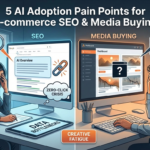
The most significant shift in 2026 is the dominance of AI Overviews (SGE). Search engines now summarize product reviews, comparisons, and “how-to” guides directly on the results page. For e-commerce brands, this means a massive drop in organic traffic to top-of-funnel blog posts.
- The Problem: Traditional SEO was built on winning the click. Now, AI provides the answer before the click happens, effectively “cannibalizing” organic traffic.
- Example: A user searches for “best organic skincare for sensitive skin.” Instead of clicking a brand’s guide, they read an AI-generated summary that pulls data from five different sites but doesn’t encourage a click-through.
- Impact: * Significant decline in informational blog traffic.
- Need to shift focus from “keywords” to “entities” and “mentions.”
- Pressure to optimize for GEO (Generative Engine Optimization) to ensure your brand is the one cited in the summary.
2. The “Creative Uncanny Valley” and Rapid Ad Decay (Media Buying)
With AI tools like Midjourney and Sora now part of standard workflows, brands are pumping out more ad creative than ever. However, this has led to a phenomenon known as “AI Slop”—ads that look high-quality but feel generic and “un-human.”
- The Problem: Because everyone is using the same AI models, ad feeds have become a sea of sameness. Consumers have developed a “sixth sense” for AI-generated visuals, leading to faster creative fatigue.
- Example: A furniture brand uses AI to generate 100 lifestyle variations of a sofa. While the first 48 hours show a high CTR, the performance falls off a cliff by day three because the imagery feels “too perfect” and fails to build an emotional connection.
- Points of Failure:
- High initial engagement that rapidly decays.
- Lack of brand “soul” or unique visual identity.
- Rising costs of “Human-in-the-loop” editing to make AI assets feel authentic.
3. Loss of Sovereignty to “Black Box” Algorithms (Media Buying)
Modern media buying is dominated by autonomous systems like Meta’s Advantage+ and Google’s Performance Max. These systems use AI to decide where, when, and to whom an ad is shown.
- The Problem: Brands are losing granular control. It is increasingly difficult to see exactly where your money is going or to apply specific brand safety exclusions without “breaking” the algorithm’s learning phase.
- Example: An e-commerce brand notices a spike in traffic but realizes the AI has been serving ads on low-quality mobile gaming apps because the “cost per click” was low, despite those users having a 0% conversion rate.
- The Pain Points:
- Difficulty in auditing platform-driven “success” metrics.
- Inability to manually pivot strategies during flash sales or PR crises.
- Heavy reliance on “machine learning” phases that can drain budgets before finding a “winning” audience.
4. The Authority Deficit in an AI-Generated Marketplace (SEO)
As AI-generated content floods the web, Google’s 2026 algorithms have doubled down on E-E-A-T (Experience, Expertise, Authoritativeness, and Trustworthiness).
- The Problem: Simply “writing a good article” with AI isn’t enough. If the content lacks “Information Gain”—new, unique data or personal experience that isn’t already in the AI’s training set—it will not rank.
- Example: A supplement brand generates 50 articles on “The Benefits of Vitamin D.” Because the AI is just rephrasing existing web data, the pages are flagged as “low value” and never break the third page of search results.
- Keys to Solving This:
- Incorporating first-party data and original research.
- Featuring real human experts (with verified social footprints) as authors.
- Prioritizing “Experience-led” content (e.g., “I tried this for 30 days”) over “Instructional” content.
5. Integration Debt and the “Dirty Data” Bottleneck (Media Buying & SEO)
AI is only as good as the data it feeds on. Most e-commerce brands are struggling with “Integration Debt”—the gap between their legacy systems (Shopify, ERPs, CRMs) and the needs of modern AI agents.
- The Problem: If your product feed is messy or your customer data is siloed, your AI-driven ads will target the wrong people with the wrong products.
- Example: A fashion brand’s AI-powered retargeting shows a “20% off” ad to a customer who just bought that exact item at full price an hour ago because the data sync between the store and the ad platform is delayed.
- Common Data Hurdles:
- Unstructured Product Data: AI cannot recommend products if descriptions lack consistent attributes (size, color, material).
- Privacy Gaps: Failing to properly implement first-party data “clean rooms” in a post-cookie world.
- Latency: Real-time AI requires real-time data; a 24-hour sync delay is an eternity in 2026.
Conclusion: Thriving in the AI Evolution
Adopting AI is no longer about which tool you use, but how you govern and differentiate it. To move past these pain points, e-commerce brands must transition from “AI-run” to “AI-orchestrated.”
The winners in this evolution will be the brands that:
- Treat Originality as their most valuable SEO currency.
- Use AI for scale, but keep humans at the center of creative strategy.
- Invest heavily in clean, first-party data architecture.
The “slop” era is ending; the era of strategic, brand-centric AI is just beginning.